 ultimate-guide
EICR Testing Costs in Preston: A 2026 Guide
Table of Contents
- What Drives EICR Testing Costs in Preston
- How Long Does an EICR Take?
- Landlord Electrical Safety Regulations in the UK
- What Happens If an EICR Fails?
- Getting an Accurate EICR Quote in Preston
- Conclusion
- Frequently Asked Questions
Last Updated: September 30, 2026
What Drives EICR Testing Costs in Preston
An EICR testing cost in Preston is not a fixed figure. It is calculated from the size of the property, the number of circuits, the age of the wiring, and how much remedial work is needed before a certificate can be issued. At GF Electrical Services, we quote every job individually because two houses on the same street can need very different amounts of work.
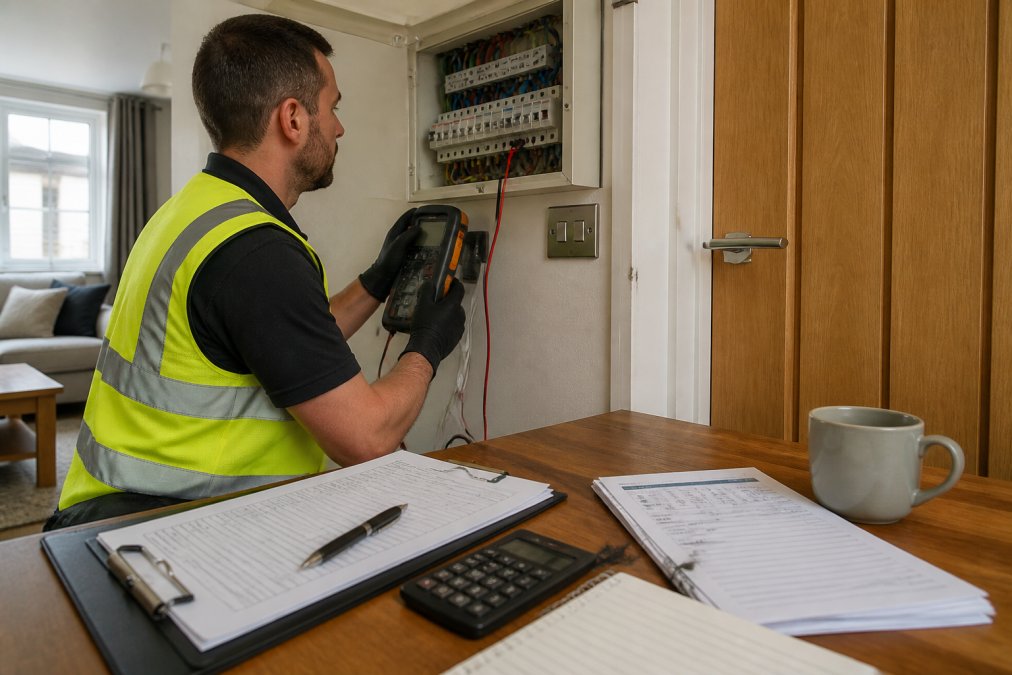
An EICR (Electrical Installation Condition Report) is a formal inspection and testing procedure that assesses whether a property's fixed wiring and electrical accessories are safe for continued use. It is not a simple visual check. The engineer isolates circuits, tests insulation resistance, verifies earthing and bonding, and records every observation against British Standard BS 7671.
Larger properties with more circuits take longer to test, and time is the single biggest factor in what you pay. Age matters just as much: older wiring often throws up faults that must be investigated before the report can be signed off.
Property Size and Number of Circuits
A one-bedroom flat might have six circuits. A four-bedroom detached house with a garage, outbuilding, and extension can easily have fifteen or more. Every circuit must be tested individually, and testing time scales roughly with the number of circuits rather than the floor area.
This is why a quote given over the phone without any detail is rarely accurate. A common mistake is accepting the cheapest verbal estimate, then discovering the final invoice is higher once the engineer counts the actual circuits on site.
Property Age and Wiring Condition
Victorian and mid-century properties frequently still contain rubber-insulated or lead-sheathed cables, outdated fuse boxes, and inadequate earthing. These do not automatically fail an EICR, but they demand closer inspection and often trigger remedial work.
Newer properties are usually quicker. Modern consumer units with residual current devices are easier to test, and the wiring is more likely to meet current standards. The gap between a modern and an older property of identical size can be substantial.
How Long Does an EICR Take?
A domestic EICR typically takes between two and four hours for an average three-bedroom house, though larger or older properties can take considerably longer. The duration depends on circuit count, accessibility of accessories, and whether faults are found.
Landlords often ask how long an EICR takes because they need to plan around tenants. In practice, the testing itself is the shorter part. Writing up observations, classifying them correctly, and producing the certificate adds time after the engineer has left.
If faults are discovered, the job pauses. The engineer must decide whether each observation is coded C1, C2, or C3, and that judgement shapes what happens next.
| Property Type | Typical Circuits | Test Duration | Main Cost Driver |
|---|---|---|---|
| One-bedroom flat | 5-8 | 1.5-2 hours | Access and parking |
| Three-bedroom semi | 8-12 | 2-3 hours | Circuit count |
| Four-bedroom detached | 12-18 | 3-5 hours | Outbuildings, extensions |
| Older property, pre-1970 | Varies | 4+ hours | Wiring condition, fault finding |
| Small commercial unit | 10-20 | 3-6 hours | Three-phase distribution |
Landlord Electrical Safety Regulations in the UK
Landlord electrical safety regulations require private landlords in England to have the fixed electrical installation inspected and tested at least every five years by a qualified person (Electrical safety standards in the private and social rented sectors: guidance). A copy of the report must be given to existing tenants within 28 days and to new tenants before they move in.
The rules are enforced by local authorities, and failing to comply can lead to financial penalties. The official guidance on electrical safety standards in the private rented sector sets out the full obligations, including what happens when remedial work is required.
For landlords with a single property in Lancashire, the process is identical to that for a large portfolio. The same five-year cycle applies, and the same certificate must be produced on request.
What Happens If an EICR Fails?
An EICR does not technically "fail." It produces one of three outcomes: satisfactory, unsatisfactory, or satisfactory with observations. An unsatisfactory report means dangerous or potentially dangerous conditions were found and must be addressed.
Observations are coded by severity:
- C1 (Danger present): Immediate risk. The circuit should be isolated straight away.
- C2 (Potentially dangerous): Urgent remedial work required, usually within 28 days.
- C3 (Improvement recommended): Not dangerous, but the installation does not meet current standards.
A C1 or C2 makes the report unsatisfactory. Once the remedial work is completed, the electrician issues a certificate confirming the installation now meets the required standard. According to Electrical Safety First guidance for homeowners and landlords, acting on C1 and C2 codes promptly is the difference between a paperwork problem and a genuine fire risk.
Getting an Accurate EICR Quote in Preston
An accurate EICR quote comes from a site visit or a detailed conversation, not a generic price list. Any provider quoting a flat figure for every property is either padding the price or planning to cut corners on the test.
When you request a quote, give the provider the following:
- Number of bedrooms and approximate age of the property
- Whether there are outbuildings, garages, or extensions on separate circuits
- Whether the consumer unit has been replaced in the last 15 years
- Whether any circuits have previously tripped or shown faults
- Whether the property is tenanted and access needs arranging
GF Electrical Services is NAPIT registered, and our engineers hold Level 3 NVQ qualifications plus the 2391 testing and inspection certification. That matters because an EICR is only as good as the person signing it. Most of our work comes from recommendations, and we quote each property on its actual condition rather than a headline rate.
For commercial premises running three-phase supplies, pricing depends on distribution board count and whether isolation can be arranged during working hours. Testing around a live business always takes longer.
Conclusion
The real challenge with EICR testing costs is that the cheapest quote and the most accurate quote are rarely the same thing. A rushed inspection that misses a C2 observation leaves you with a certificate that will not protect you when it matters.
GF Electrical Services provides 18th Edition BS7671 compliant testing, inspection, and remedial work across Preston and the surrounding areas. Our engineers are Level 3 NVQ qualified, hold 2391 testing and inspection certification, and are NAPIT registered, with public liability insurance covering every job. Whether you are a landlord with one property or a business running a three-phase supply, we will quote based on what your installation actually needs. Contact GF Electrical Services to arrange your EICR and get a clear, honest assessment of your property's electrical safety.
Frequently Asked Questions
How much does an EICR cost on average?
There is no single average figure because EICR testing costs depend on property size, age, the number of circuits, and how accessible the wiring is. A one-bedroom flat will cost less to test than a large period property with outbuildings. Rather than quote a generic number, GF Electrical Services assesses each property individually. Contact us directly for a tailored quote based on your property's specific requirements.
Is an EICR a legal requirement for landlords?
Yes. Under landlord electrical safety regulations, private landlords in England must have a valid EICR for each rental property at least every five years. The report must be given to existing tenants within 28 days of inspection and to new tenants before they move in. Failing to comply can result in financial penalties, so it is essential to keep certificates current and store them safely.
What happens if an EICR fails?
If an EICR fails, the report will identify defects coded C1, C2, or C3. C1 and C2 issues mean the installation is unsafe and remedial work is required. For landlords, C1 and C2 faults must be fixed within 28 days, or sooner if the report specifies. GF Electrical Services can carry out the remedial work and issue a satisfactory certificate once the installation passes.
How long does an EICR take to complete?
How long an EICR takes depends on the property. A typical one or two-bedroom flat may take two to three hours, while a larger four-bedroom house could take four to six hours. Commercial premises with three-phase supplies take longer. The electrician needs time to inspect every circuit, test accessories, and complete the detailed report.