 ultimate-guide
Benefits of Smart EV Chargers for Residential Use
Table of Contents
- What Makes a Smart EV Charger Different From a Standard One
- How Smart EV Chargers Cut Your Charging Costs
- EV Charger Off-Peak Charging Benefits for Homeowners
- EV Charger Load Balancing Explained: Why It Protects Your Home
- OZEV Grant Requirements for Home Chargers: What You Need to Know
- Installation and Compliance: What a Qualified Electrician Checks
- Frequently Asked Questions
Last Updated: October 2, 2026
What Makes a Smart EV Charger Different From a Standard One
A smart EV charger is a wall-mounted charging unit that connects to your home network and lets you control when, how fast, and at what cost your electric vehicle charges. Unlike a basic untethered unit that simply delivers power the moment you plug in, smart chargers manage the whole process.
The practical difference comes down to three things. Smart units schedule charging sessions around cheaper energy windows, they balance the electrical load across your home's existing supply, and they report consumption data you can actually act on. A standard charger does none of this. It charges when you plug in, at whatever rate the vehicle demands, regardless of what your tariff or your fuse board can comfortably handle.
That distinction matters more than most homeowners realise before they buy. According to GOV.UK guidance on electric vehicle home charging, the vast majority of EV charging happens at home overnight, which makes the timing and control features of smart chargers the ones that pay for themselves.
At GF Electrical Services, we install these units across Preston and the surrounding areas, and the questions we get are almost always the same: will it save me money, and will it overload my supply? Both answers start with understanding what smart control actually does.
How Smart EV Chargers Cut Your Charging Costs
Smart EV chargers reduce running costs by shifting charging into cheaper energy periods and by making use of power you generate yourself. Two mechanisms do most of the work.
Scheduling Around Your Energy Tariff
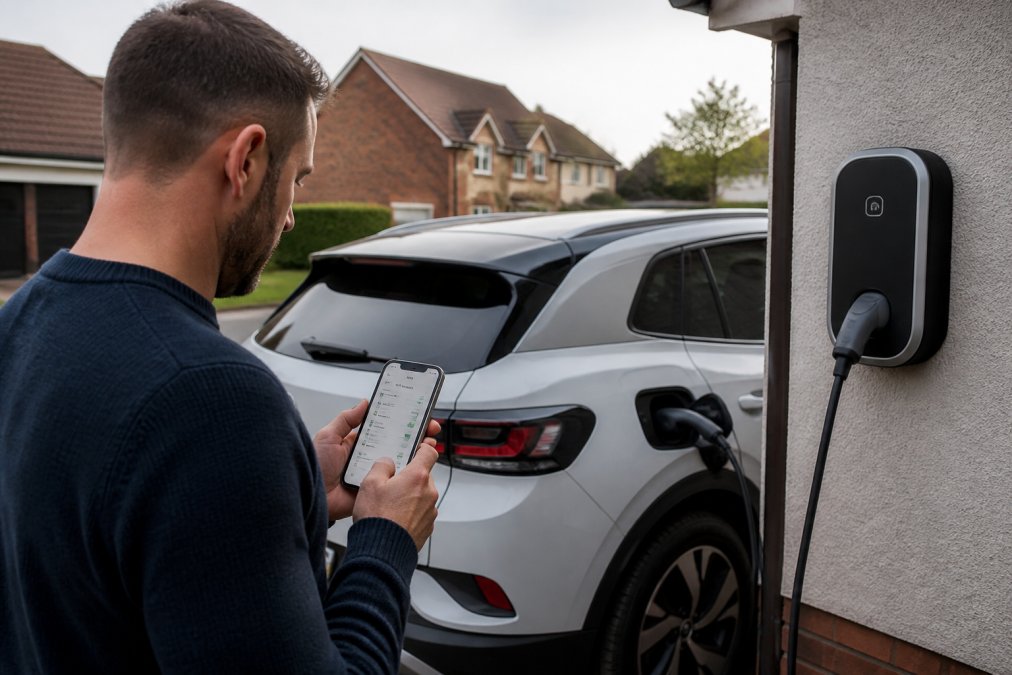
Time-of-use tariffs charge different rates depending on the hour. A smart charger reads your tariff and automatically starts charging during the cheapest window, usually overnight. You plug in at 6pm, the car waits, and it charges at 1am when rates drop.
The charger handles this without you thinking about it. Set the schedule once and it repeats. If your tariff changes, you update the app and the charger adapts.
Pairing With Solar and Battery Storage
If you have solar panels, a smart charger can divert surplus generation into the car instead of exporting it to the grid at a lower rate. Add a home battery and the charger can pull from stored energy during peak hours, keeping your import near zero.
EV Charger Off-Peak Charging Benefits for Homeowners
Off-peak charging is the clearest financial argument for going smart. Overnight electricity rates on time-of-use tariffs are typically a fraction of peak rates, and a smart charger is what lets you reliably capture that difference without remembering to plug in at midnight.
The benefits go beyond the bill:
- Lower cost per mile than peak-rate charging
- Reduced strain on the grid during high-demand hours
- Better use of renewable generation, which is more abundant overnight
- Consistent charging routine that fits around work and sleep
For households doing most of their mileage on home charging, the cumulative effect on annual running costs is significant. The key is that off-peak rates only help if your charging actually happens off-peak, which is where automation earns its place.
EV Charger Load Balancing Explained: Why It Protects Your Home
Load balancing is the feature that stops a charger from overloading your home's electrical supply. It continuously monitors how much power the rest of your property is drawing and reduces the charger's output so the total stays within your supply's safe limit.
Here's why that matters. A 7kW charger pulls roughly the same current as an electric shower, an oven, and a tumble dryer running together. Without load balancing, charging while you cook dinner can trip the main fuse or, worse, stress wiring that was never sized for that combined demand.
A load-balanced charger avoids the problem entirely. It throttles back when your home is busy and ramps up when demand drops. You get a full charge by morning without ever risking the supply.
OZEV Grant Requirements for Home Chargers: What You Need to Know
The government's grant scheme for home chargepoints has changed several times, and the current rules are narrower than many homeowners expect. Eligibility depends on your property type, your existing parking arrangements, and the installer's accreditation.
Because the specific criteria and any grant amounts are updated periodically, the reliable approach is to check the official OZEV chargepoint grant guidance directly before assuming you qualify. What has remained consistent is the requirement that the chargepoint and the installer both meet the scheme's standards, which is why using an accredited electrician matters.
For most homeowners, the practical takeaway is this: confirm eligibility early, and make sure whoever installs your charger can provide the documentation the scheme requires. Getting that wrong after the work is done is difficult to unwind.
Installation and Compliance: What a Qualified Electrician Checks
A compliant installation is not just about mounting a box on the wall. Before any charger goes in, a qualified electrician assesses the property's supply, earthing arrangements, and protective devices against the requirements of BS 7671, the wiring regulations.
The checks that matter most:
- Available supply capacity and whether load balancing is needed
- Earthing and bonding arrangements, including any earth electrode requirements
- Correct protective device selection and RCD protection
- Cable routing, sizing, and mechanical protection
- Notification and certification of the work
| What Is Checked | Why It Matters | Who Confirms It |
|---|---|---|
| Supply capacity | Prevents overload and nuisance tripping | Qualified electrician |
| Earthing and bonding | Ensures fault protection works correctly | Qualified electrician |
| Protective devices | Meets BS 7671 requirements | Qualified electrician |
| Cable sizing and routing | Safe current-carrying and physical protection | Qualified electrician |
| Certification | Proves compliance for insurance and records | Registered installer |
This is where GF Electrical Services' approach differs from a rushed job. Our engineers work to the 18th Edition of BS 7671, are Level 3 NVQ qualified, and hold NAPIT registration, so the installation is certified and the paperwork stands up to scrutiny. Most of our work comes from recommendations, which tells you more about how we operate than any sales pitch could.
If you are weighing up a home charger, the safe route is to have the property assessed properly before committing. Contact GF Electrical Services to arrange an installation that meets current regulations and protects your home.
Choosing the right charger is only half the decision; the other half is having it installed correctly on a supply that can genuinely take it. A poorly specified unit on an unprepared installation creates risk that no app feature can offset. GF Electrical Services brings 20 years of expertise, 18th Edition BS 7671 compliance, and NAPIT-registered engineers to every installation, so your charger is safe, certified, and set up to save you money from the first charge. Get started with GF Electrical Services and charge at home with confidence.
Frequently Asked Questions
What is the difference between a standard and a smart EV charger?
A standard charger starts charging the moment you plug in and stops when the car is full. A smart charger connects to your home Wi-Fi and lets you schedule charging, monitor energy use through an app, and respond to signals from your energy supplier. That means you can charge overnight when electricity is cheaper, or link charging to solar generation. For most households with a time-of-use tariff, the scheduling alone makes a smart unit worth the small extra cost.
Do smart EV chargers require a specific type of internet connection?
Most smart chargers need a stable 2.4GHz Wi-Fi connection at the installation point, which is usually fine if your router is within reasonable range of the driveway or garage. Some models support 4G or Ethernet as alternatives. If your Wi-Fi signal is weak where the charger goes, a mesh extender or a wired connection solves it. Your installer should test the signal during the site survey so the smart features work reliably from day one.
Can smart EV chargers integrate with solar panels?
Yes, many smart chargers can be configured to prioritise solar generation. When your panels are producing more than the house is using, the charger diverts that surplus into the car instead of exporting it to the grid at a lower rate. Some systems also work with home battery storage, charging the battery first and the car second. This setup reduces how much grid electricity you buy, though it needs a compatible charger and inverter, so confirm compatibility before installation.
Are smart EV chargers mandatory for new home installations?
Since June 2022, new homes and buildings undergoing major renovation in England must have an EV charge point installed where parking is available, under Part S of the Building Regulations. The charger must meet smart functionality requirements. If you are retrofitting a charger to an existing home, it is not mandatory, but choosing a smart-compliant unit keeps you eligible for grants and future-proofs the installation. Your electrician can confirm what applies to your property.